
The idea to explore ‘article titles’ and their influence on scholarly community came up while we were working on a project examining the reporting standards of academic articles in management. We noticed that several other disciplines have thoroughly examined the attributes of article titles and sometimes, even their role in making the concerned articles more attractive to the intended audience. (Furthermore, it seemed like a fun project to work on!)
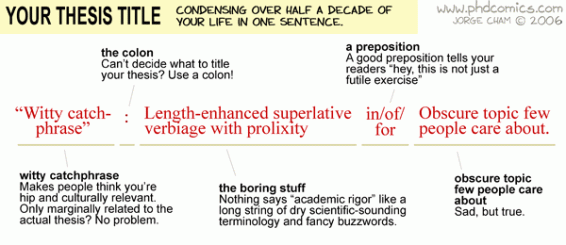
So, what makes a “good” title for an article, i.e. one which might attract citations in the academic community? Answers to this question are manifold, though inconclusive across disciplines. In an attempt to provide cohesion, in our article – What makes a ‘good’ title and (how) does it matter for citations? A review and general model of article title attributes in management science (Nair. L.B., & Gibbert. M. Scientometrics, 107 (3), 1331-1359), we integrate significant title characteristics from previous studies across disciplines into a comprehensive model and link it with citation count. Keeping the application context constant, we focus on management science.
We find that only ‘non-alphanumeric characters’ and a ‘balanced’ title structure have small, but significant effects on citation count. Titles with non-alphanumeric characters appear to have a negative relationship with citation count, whereas the ones with balanced structure seem to have a slightly positive association. Surprisingly, attributes which tended to show significant effects in other disciplines (though often in opposite directions), such as length, context, and linguistic attributes exhibit no relationship with citation count. So next time you are thinking of an attractive title which would make your article more visible to the management scholars, keep in mind that a simple balanced structure with fewer colons might be the way to go!

 LAKSHMI B. NAIR